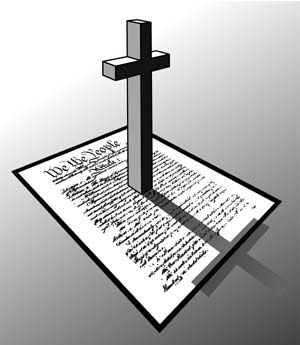
 Under the United States Constitution the state cannot make any law that prohibits, or in effect sanction a religion. In the end what we have is a neutral clause of our founding document stating that government cannot approve or disapprove someone's religion or church. Does that mean that the state must also remain neutral on the actions of religious people?
Recently a bill is making its way through in Kansas that would in essence allow not religious institutions but people of any faith to discriminate against gays and lesbians as they see fit. This rather new innovation is gaining some steam in other states as well. Some who support such legislation argue that people have a right to act upon their religious convictions even though such actions (not convictions) can have a negative and damaging impact on someone else outside their church.
This is setting new precedent that for the first time in history the state will allow people to be exempt from a law or a contractual obligation if such law or obligation under the relative view of the person under such law or obligation that a certain negative reaction to the law or obligation must therefore take place due to the religious beliefs of such a person. This is not the first amendment. The first amendment allows people to believe what they want to believe and voids any action against a person simply for holding a belief that is not popular. That is why the religious freedom clause is under the same amendment as the freedom of the press and speech because our framers of the constitution knew that government would try in the future to oppress that for which is unpopular namely controversial publications, speech and minority religions. The main premise underlining these principles is not actions but rather thought. A thought is not an action but rather a set of ideas that are constructed in someone's mind. Ideas cannot cause any harm because they simply cannot manifest by themselves out of someone's head in a magical way to actually hurt someone. For instance, if Jack thinks of a mallet to hit John with, the mallet in is head does not magically pop out of his head and actually hit John causing injury; however, if Jack goes to the hardware store and buys a mallet and then hits Jack with it, then we are talking about someone's actions, not thoughts or beliefs. The first amendment protects thought not action.
If one were to make the case that someone of faith has a constitutional right to act on his beliefs than we must say that the attacks on 9/11 were not criminal and that the terrorists behind such plot must be found innocent since according to their own rational relativism they were acting out according to their beliefs and calls from Allah. Polygamists must therefore also be entitled to marry multiple wives and have sex with minors since according these faithful it is all according to their beliefs.
Once we start carving out "exemptions" on the grounds of religious actions (instead of beliefs) then there is no stopping how far certain citizens' criminal actions can be excused for their own leisure and relativism. If one is exempt from the law to discriminate against gays, why not also from murdering gays? Leviticus tells us that gays, according to some Christian and Muslim extremists, must be executed. There are few Americans who are advocating for the death penalty for homosexuality. But this is a bit different since these individuals are saying that the state should bare the responsibility of actually executing gays not citizens. Upon reading the book of Leviticus more closely it does not command the state to kill gays but rather those who witness the homosexual act. An extremist's wish and desire to murder gays must therefore be honored and granted under this supposed "religious freedom to act upon my beliefs" scheme that is now being proposed.
Of course, the possibilities are endless since there are so many religious sects of many colors and variety. A reader may find the examples given extreme, however we must remember that we live among extremists and it is not far fetched since many of them have expressed such feelings of murdering gays even though the legalization of murdering gays is almost unrealistic at least in America. We could then entertain a less extreme but more plausible situation that could arise from bills like the one in Kansas that is mentioned in the beginning: lets say that there is a fire at a gay club and there many patrons stuck inside. A call is put in and the local fire station a couple of miles away receives the call from dispatch. All of the firemen are devout Christians of the extreme conservative variety and whose view on homosexuality and gays are very condemning and that any help for the advancement of that 'lifestyle' is a ticket to hell. The firemen find themselves (under their own relativism) in a predicament. It is their job to put out fires and rescue people but as Christians they know that the law now states that they can discriminate against gays since their relativism tells them that their denial of life saving services to homosexuals is now a mandate from their faith. They decide to call dispatch and to have another station instead put out the fire at the evil homosexual club. But Kansas being a rural state the next fire station is 20 miles away and will take around 15 minutes to arrive. After much fighting between dispatch and the Christian firemen the other station gets the call and heads to burning gay club. Upon arrival the club is all burned down to the ground and more than 200 people have been burned alive, suffocated or stampeded to death. Services have been delayed for more than 20 minutes. In this case, are the firemen responsible for the loss of life? No they are not because the new law tells them that any person is under no obligation to provide a service, even as important as fire rescue, to any homosexual as long as it violates (under the firemen's relativism) their religious convictions. This can include ambulance care and other services. There is law that forces firefighters and ambulances to respond to every call, but that can be trumped very easily since the intention of these "religious exemptions" is to protect a "fundamental constitutional right" which is the right to act out on your religious beliefs when rendering services to gays and then of course these laws that allow anti-gay discrimination are established to trump other laws that already exist anyway, so you might say that law trumping is already set precedent.

No comments :
Post a Comment